
Review, accept and retain
Let customers and carriers review and sign from the email
The recipient follows an email invitation, verifies access and reviews the agreement. Customer terms and carrier rate confirmations each have their own signing workflow.
At a glance
How it works
- Open and verify the invitation
The designated recipient verifies access to their email address; no new portal account is needed.
- Review and accept
Customers acknowledge each clause. Carriers sign their rate confirmation and provide the required equipment details.
- Return to the signed record
Staff can find the retained copy and completion history under the customer or shipment.
Signing access is limited to that invitation. Carrier driver and equipment details are required unless staff specifically allow early signing.
Read the detailed guide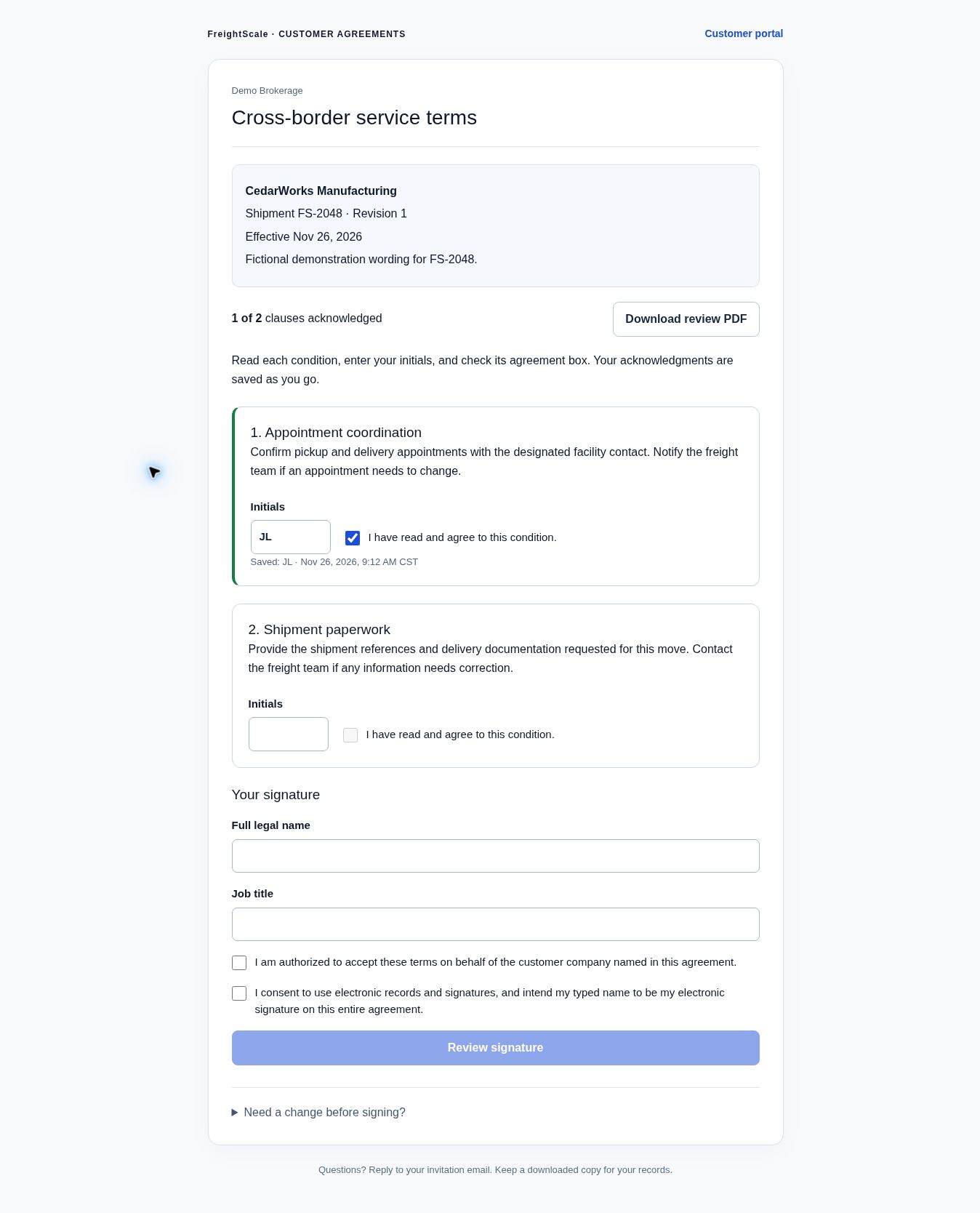 Enlarge screenshot
Send the reviewed document to its designated signer
Staff prepare and review the document before sending its invitation. The recipient opens the email link and verifies access with a code sent to the designated email address. The signing page works on a phone, and does not require creating a portal account.
An invitation authorizes that signing workflow. It does not grant general customer or carrier portal access. For rate confirmations, copied recipients do not gain the designated To recipient’s signing authority.
Customer agreements: acknowledge each clause
The customer reviews the issuing company, scope, effective date and clause wording. Each clause requires initials and acknowledgment. The signer then reviews the final step, enters their name and title, and separately confirms authority to accept and consent to electronic signing.
Progress remains attached to the issued terms. Staff can send a reminder or renew an expired link without erasing acknowledgments to the same agreement. If the wording changes, staff issue a revision for review.
Rate confirmations: accept the assignment and provide equipment details
The carrier reviews the rate confirmation and its terms, enters a name and title, and types or draws a signature. Driver name, phone, truck and trailer details are normally required.
A per-carrier setting can permit signing before all driver and equipment details are available, with an explicit acknowledgment that the information is pending. Acceptance belongs to that carrier assignment and document version. On a multi-carrier load, it does not expose another carrier’s charges.
Return to the signed copy and its history
Completed customer agreements are retained under the customer and in the customer portal. Signed rate confirmations appear in shipment Documents and Dispatch → Rate confirmation signatures. Completed copies are queued for email delivery through the relevant workflow.
The retained records include the accepted document or clause versions, signer information, verification and completion details. A newer revision preserves completed history. A separately returned signed rate-confirmation PDF can also be recorded as a manual return, with that method identified in the history.
Follow the paperwork through the load
Before dispatching FS-2048, staff can check whether CedarWorks Manufacturing has completed the applicable customer agreement. Northline Transport then signs its own rate confirmation and supplies the equipment details for the Dallas pickup.
When the yard later asks which carrier accepted the assignment, staff can open the relevant signed confirmation. The customer’s contract and the carrier’s acceptance remain distinct records with their own audience and history.
Common questions
Can customers and carriers sign on a phone?
Yes. Both signing pages support mobile review and completion through the invitation link.
Can a carrier sign before knowing the trailer number?
Only when staff enable early signing for that carrier. Missing details must be acknowledged as pending; the default requires the full driver and equipment information.
What happens to a signed copy when a revision is issued?
Completed records remain in the archive. A newer issued invitation replaces an older unfinished invitation for its scope without rewriting the previously completed record.